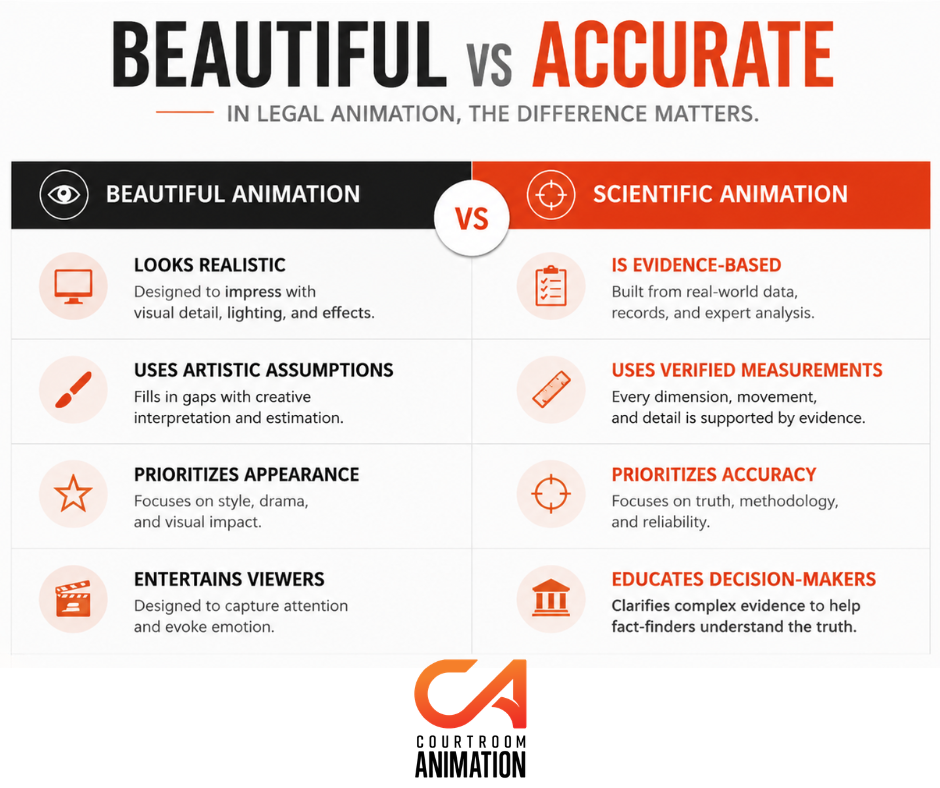
If you’ve ever watched a Hollywood movie, you’ve probably seen visual effects that look completely real.
Scientific legal animation is different.
Our goal isn’t to impress people. Our goal is to accurately explain what happened using reliable evidence that experts can support and courts can trust.
Those are two very different objectives.
In our industry, beautiful graphics may capture attention. Scientific accuracy earns credibility. More importantly, it helps attorneys present demonstrative evidence that experts can support and courts can trust.
That’s why we believe scientific accuracy matters far more than beautiful animation.
Scientific Legal Animation Starts With Evidence
Every successful legal animation begins long before anyone opens a 3D software program.
Instead, every project starts with evidence.
We gather information from every available source, including:
- accident reconstruction reports
- deposition testimony
- laser scan data
- drone imagery
- engineering reports
- medical records
- surveillance video
- scene photography
- witness statements
Only after we understand the evidence do we begin building a three-dimensional environment. From there, every model is developed to reflect the available facts.
The animation isn’t creating facts. It’s illustrating them.
Beautiful Animation Can’t Fix Bad Science
One of the biggest misconceptions about courtroom animation is that realism alone makes it persuasive.
It doesn’t.
An animation can feature cinematic lighting, detailed textures, and realistic vehicles.
However, even the most visually impressive animation loses credibility if the vehicle speeds are wrong or the line-of-sight study doesn’t match the evidence.
Experienced attorneys know jurors appreciate realism. Experts appreciate accuracy. Judges require both.
Scientific Accuracy Builds Confidence
Our process revolves around verification.
Every important measurement comes from evidence.
Every movement is supported by expert opinions.
In addition, every environmental detail should reflect the actual conditions at the time of the incident.
Sometimes that means recreating:
- weather conditions
- roadway markings
- vegetation
- lighting
- construction zones
- equipment configuration
These details may seem minor. Often, they’re the difference between an ordinary animation and one that becomes a valuable demonstrative exhibit.
Real-World Example: Recreating a Scene That Has Changed
Accident investigations don’t always happen immediately.
By the time attorneys and experts inspect a scene, the environment may look very different from the way it did when the incident occurred. Trees may have been removed, road markings may have changed, or new signs and other structures may have been added.
Courtroom Animation has encountered this exact challenge in accident reconstruction. In one case, the roadway had changed considerably between the time of the collision and the site inspection. The team used forensic animation to recreate the scene as it existed at the time of the accident — essentially creating a visual “time machine” for the fact finder.
In another motorcycle accident case, the available evidence did not include investigative photographs of the original roadway condition. The legal team conducted additional investigation, including drone-based 3D laser scanning of a eucalyptus tree and the broken limb involved in the crash. The scan data helped establish a connection between the limb struck by the motorcycle and the tree from which it had fallen.
These examples illustrate why scientific legal animation is different from simply creating a realistic-looking scene. The goal is to reconstruct the environment and events from available evidence — not to invent what the scene might have looked like.
Common Mistake: Prioritizing Visual Style
Some animation companies focus first on making graphics look dramatic.
We approach the process differently.
Accuracy drives every creative decision.
The best compliment we receive isn’t “That looked amazing.” It’s when an expert tells us,
“Yes—that’s exactly what happened.”
2026 Trend: Legal Animation Is Becoming More Data-Driven
Legal animation is increasingly incorporating real-world measurements, digital records, and other forms of objective data.
Depending on the case, a reconstruction may incorporate:
- LiDAR/laser-scanned measurements
- drone imagery and photogrammetry
- event data recorder (EDR) information
- CAD and engineering files
- point-cloud data
- biomechanical analysis
These technologies don’t eliminate the need for expert analysis. Instead, they give experts and animators more information to work from when reconstructing an event.
For example, NIST’s forensic-science work on terrestrial laser scanners specifically focuses on evaluating the accuracy and precision of the measurements produced by these instruments.
The result is a reconstruction based increasingly on measurable evidence rather than visual guesswork.
Why It Matters to Attorneys
Scientific accuracy does more than improve an animation, it strengthens confidence.
Attorneys know the animation has a defensible foundation.
Experts know their opinions have been represented correctly.
Judges know the demonstrative exhibit reflects reliable methodology.
Jurors understand complicated events more clearly.
Everybody benefits.
The Bottom Line
At Courtroom Animation, we don’t start with software, we start with evidence.
Every project we complete reflects the same philosophy we’ve followed for decades:
The animation should never become the story. The facts should.
Beautiful graphics may catch someone’s attention. Scientific accuracy earns their trust.
If you’re preparing for mediation, arbitration, or trial, we’d be happy to discuss how scientifically accurate animation can help your team communicate complex evidence with clarity and confidence.
Free eBook: The Complete Introduction to Forensic Animation

Whether you are considering animation for one of your cases, or you simply want to be prepared for when the other party uses an animation, our eBook is your guide to understanding forensic animation.