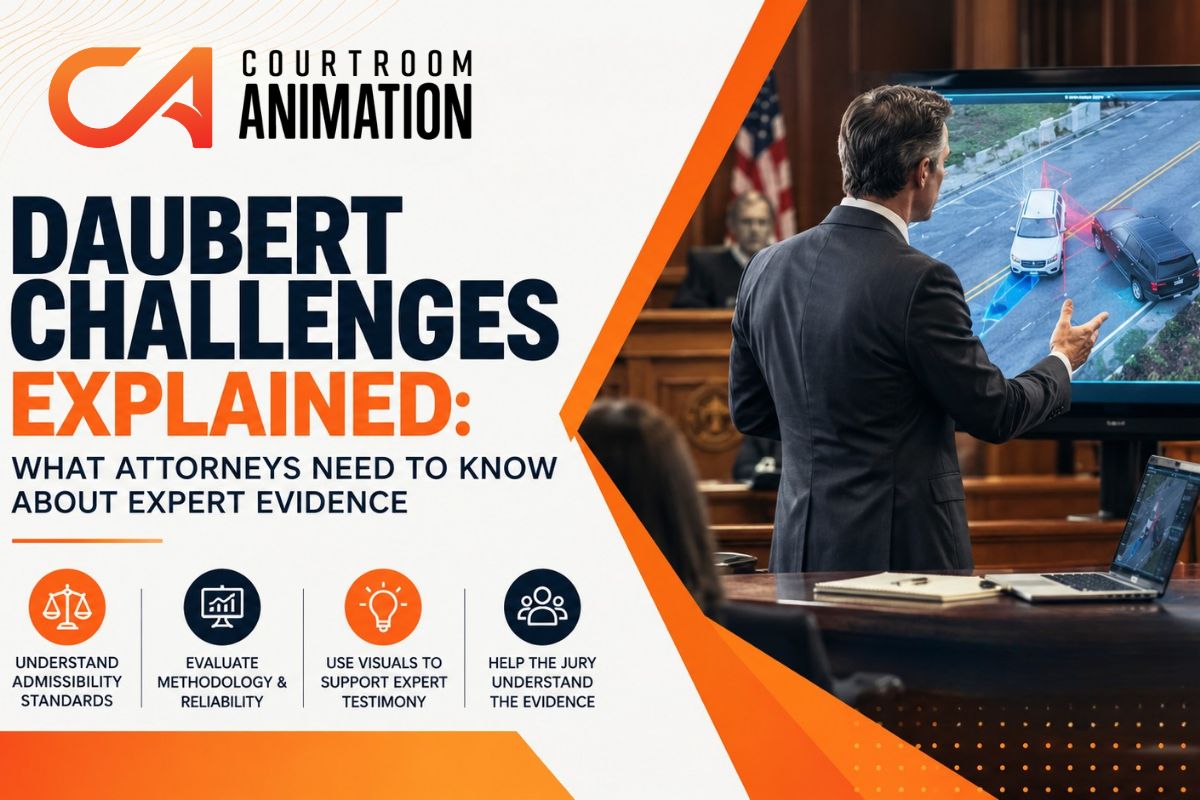
A courtroom can turn on one question: Will the judge allow the evidence in?
For attorneys relying on expert testimony, that question often leads directly to a Daubert challenge. A strong expert can clarify complicated issues, but an unreliable methodology can create a serious weakness before trial even begins.
At Courtroom Animation, we work with legal teams that understand one thing: complex evidence must be explained clearly. Whether an expert is discussing medical findings, accident reconstruction, engineering analysis, or scientific data, the way information is presented matters.
So, what exactly is a Daubert challenge, and why should attorneys pay attention?
What Is a Daubert Challenge?
A Daubert challenge is a legal argument that questions whether an expert’s testimony meets the requirements for admissibility in court.
The goal is simple: determine whether the expert’s opinions are based on reliable methods and relevant information.
The standard comes from the landmark case Daubert v. Merrell Dow Pharmaceuticals, Inc. and has become a foundation for evaluating expert testimony in federal courts.
However, a Daubert challenge is not about whether the judge agrees with the expert’s conclusion.
Instead, the court examines how the expert reached that conclusion.
A judge may consider questions such as:
- Was the expert’s methodology tested?
- Has the approach been reviewed by other professionals?
- Does the method have a known error rate?
- Are there accepted standards controlling the process?
- Does the expert’s reasoning fit the facts of the case?
Therefore, attorneys preparing expert testimony must focus not only on the answer but also on the process behind the answer.
Why Daubert Challenges Matter to Attorneys
Expert testimony can influence how juries understand complicated evidence. However, before a jury ever hears that testimony, the court must determine whether it belongs in the courtroom.
A successful Daubert challenge may limit or exclude expert opinions.
As a result, attorneys should evaluate expert evidence early in litigation rather than waiting until trial preparation.
For example, consider a personal injury case involving a complicated accident reconstruction.
An expert may explain vehicle movement, impact forces, and visibility conditions. Yet, if opposing counsel questions the reliability of the reconstruction method, the expert’s conclusions may face additional scrutiny.
This is where preparation becomes critical.
How Attorneys Prepare for a Daubert Challenge
Strong preparation begins with understanding the expert’s foundation.
Before trial, attorneys should review:
The Expert’s Qualifications
A professional title alone does not automatically establish expertise.
Attorneys should examine:
- education
- professional experience
- publications
- certifications
- prior testimony history
- industry recognition
The Expert’s Methodology
The court is interested in how the expert reached the opinion.
Therefore, attorneys should understand:
- what information was analyzed
- what assumptions were made
- what tools were used
- whether alternative explanations were considered
The Presentation of Complex Evidence
Even reliable expert opinions can become difficult for jurors to understand.
That is why many legal teams use demonstrative evidence, including:
Visual evidence does not replace expert testimony. Instead, it helps explain the expert’s reasoning.
How Forensic Animation Supports Expert Evidence
At Courtroom Animation, we often see the same challenge attorneys face: the evidence may be clear to the expert but confusing to everyone else.
A jury may not understand:
- how an injury occurred
- what happened during a collision
- how a mechanical failure developed
- why a medical condition resulted from an event
A carefully created forensic animation can help translate technical information into a visual story.
For example, an accident reconstruction expert may describe vehicle speeds, angles, and impact sequence. A visual recreation can help demonstrate those same concepts in a way that is easier to follow.
The key is accuracy.
A courtroom animation must be based on evidence, supported by expert analysis, and designed to clarify—not exaggerate.
Common Mistakes Attorneys Make With Expert Evidence
Even experienced legal teams can encounter challenges when preparing expert testimony.
Mistake #1: Waiting Too Long to Evaluate Expert Evidence
A Daubert issue should not be discovered days before trial.
Early review allows attorneys to identify weaknesses and strengthen the foundation of expert opinions.
Mistake #2: Focusing Only on the Expert’s Credentials
A qualified expert can still face challenges if the methodology is questioned.
Courts look beyond resumes. They examine reliability.
Mistake #3: Using Visual Evidence Without Proper Foundation
Demonstrative evidence is powerful, but it must accurately represent the facts.
An effective courtroom animation should support testimony, not create confusion.
2026 Trend: The Growing Role of Visual Evidence in Litigation
As cases become more technically complex, attorneys are increasingly looking for ways to make evidence easier to understand.
In 2026, we expect continued growth in:
- interactive courtroom presentations
- advanced 3D visualization
- medical and scientific animations
- technology-assisted litigation preparation
However, technology alone is not the solution.
The strongest courtroom visuals combine accurate evidence, expert knowledge, and thoughtful storytelling.
What Attorneys Should Know Before Facing a Daubert Challenge
A Daubert challenge is ultimately about trust.
The court must trust that the expert used reliable methods. The jury must trust that the evidence is understandable and accurate.
For attorneys, the best preparation includes reviewing expert opinions early, understanding the methodology behind them, and presenting complicated information clearly.
At Courtroom Animation, our role is helping legal professionals communicate those complicated ideas through accurate visual storytelling.
Because when evidence is difficult to explain, the right visual can make all the difference.
Frequently Asked Questions About Daubert Challenges
What is the purpose of a Daubert challenge?
A Daubert challenge evaluates whether expert testimony is reliable and relevant enough to be presented in court.
Does a Daubert challenge eliminate an expert witness?
Not always. A court may exclude an expert’s testimony entirely, limit certain opinions, or allow the testimony with restrictions.
Is Daubert used in every state?
Not every state follows the same expert testimony standard. Some jurisdictions use different approaches, although many have adopted standards influenced by Daubert.
Can demonstrative evidence help with expert testimony?
Yes. Demonstrative evidence can help explain complex expert opinions when it accurately represents the underlying facts and methodology.
Why are courtroom animations useful?
Courtroom animations can help attorneys explain technical evidence, medical concepts, accident sequences, and scientific opinions in a more understandable way.
At Courtroom Animation, we don’t start with software, we start with evidence.
If you’re preparing for mediation, arbitration, or trial, we’d be happy to discuss how animation can help your team communicate complex evidence in a clear way.
Free eBook: The Complete Introduction to Forensic Animation

Whether you are considering animation for one of your cases, or you simply want to be prepared for when the other party uses an animation, our eBook is your guide to understanding forensic animation.