Courtroom Animations Remove Complexity
Jurors enter a case feeling overwhelmed. They’ve been pulled from work, family, and daily life to make a decision that could change someone’s future. Therefore, the information they receive must be clear and easy to understand. Courtroom animations accomplish this by offering jurors a visual reenactment rather than requiring them to interpret complex details from a whiteboard.
Here are the five steps we take in every case to ensure jurors receive the clearest and most effective visuals to aid in their decision-making.
1. Breaking Down Complex Information
The first step is identifying what needs simplification. Legal concepts can often be full of technical details, and if jurors don’t grasp them, they won’t connect with the case. To address this, we collaborate closely with attorneys to pinpoint key moments where a visual can turn confusion into clarity. Whether it’s a contract dispute, medical malpractice, or an accident timeline, an animation effectively distills the information to the essentials.
Watch an example of breaking down complex information here.
2. Engaging and Holding Juror Attention
Jurors face a flood of information, making it crucial to keep them engaged throughout the trial. A well-timed animation grabs their attention, breaks up the monotony, and makes key points easier to remember. People naturally connect with visual storytelling, and in the courtroom, this connection can make all the difference in keeping jurors focused on critical facts rather than getting lost in irrelevant details.
3. Making Emotional Connections
A courtroom animation does more than simplify—it makes an emotional impact. It can highlight key moments in a way that sticks, show pain and suffering without being graphic, or illustrate negligence in a way that is undeniable. In addition, animations humanize the experience, making it easier for jurors to emotionally connect and understand the significance of the case. Ultimately, this emotional connection can reinforce key arguments and resonate deeply with the jury.
4. Neutralizing Bias with Clear, Unbiased Visuals
Jurors bring their own biases, and raw evidence can provoke emotional reactions that distract from the facts. However, animations control the narrative by presenting information in a clear, direct, and neutral way, free from unnecessary distractions. This helps keep jurors focused on what actually happened, ensuring they stay grounded in the facts rather than subjective interpretations.
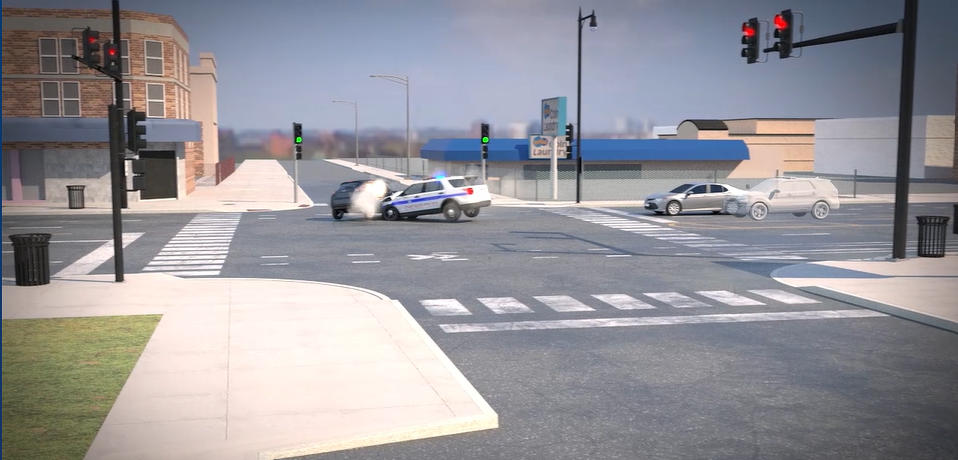
Still shot of an accident reconstruction by Courtroom Animation’s CEO & Founder, Brady Held
5. Adapting to Any Budget and Case Type
Not every case has a large budget for visual strategy, but a compelling exhibit remains within reach. In fact, our services are scalable—whether it’s a simple graphic, detailed reenactment, or 3D reconstruction, there’s always a solution that fits the case. Jurors today actively process information visually, and even basic animations can significantly enhance their understanding.
In conclusion, courtroom animations more than just visuals—they’re tools that simplify, clarify, and strengthen arguments, ensuring jurors don’t just hear the case but truly understand it.
Make Your Case Unforgettable!
Trial graphics are more than just visuals—they are powerful litigation tools that enhance understanding, strengthen arguments, and drive favorable verdicts. Courtroom Animation has successfully supported over 2,000 cases with a 99% admissibility rate. If you’re ready to elevate your case with cutting-edge trial graphics, reach out today for a competitive quote.

Whether you are considering animation for one of your cases, or you simply want to be prepared for when the other party uses an animation, our eBook is your guide to understanding forensic animation.