Premises liability cases often turn on unseen, incremental damage that happens over several years.
However, explaining slow micro-movements to a jury using only static photos and expert jargon can leave room for defense doubt.
In a recent premises liability case, a pedestrian suffered a depressed skull fracture and an intracranial hematoma when a metal lamppost finial fell from above at a city crosswalk. By using 3D forensic animation premises liability visualizations, the trial team clearly demonstrated the long-term failure mechanism and severe blunt force impact, ultimately securing a $23 million verdict.
The Case Mechanics: A Freak Accident or Foreseeable Failure?
The defense initially framed the event as an unpreventable, sudden freak accident caused by nature.
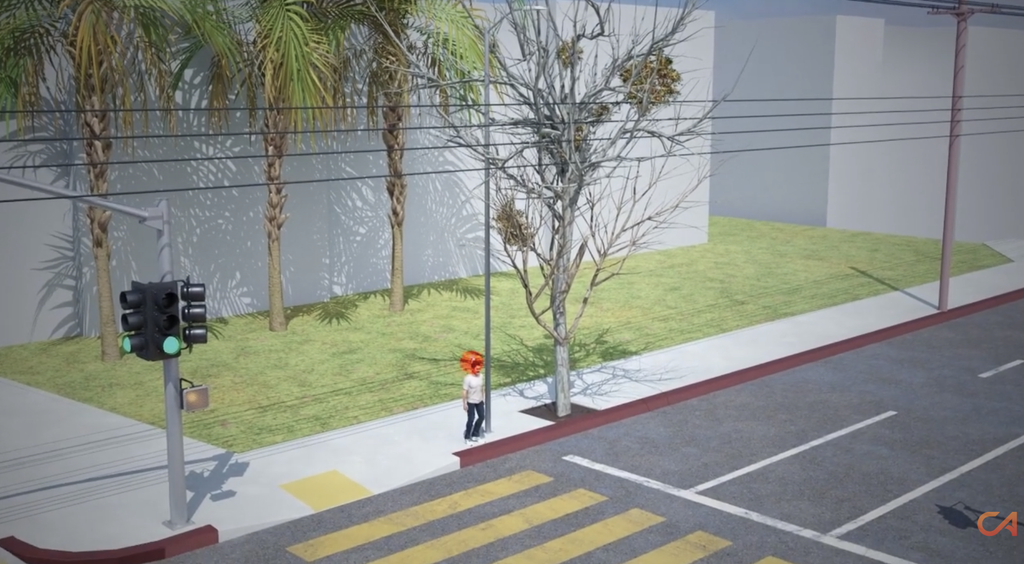
On the day of the incident, a pedestrian stopped at a busy crosswalk directly underneath a municipal lamppost. Without warning, the heavy decorative top cap—known as a finial—detached, fell from the top of the post, and struck the pedestrian below, fracturing the skull and causing a traumatic hematoma.
Proving Incremental Friction over Time
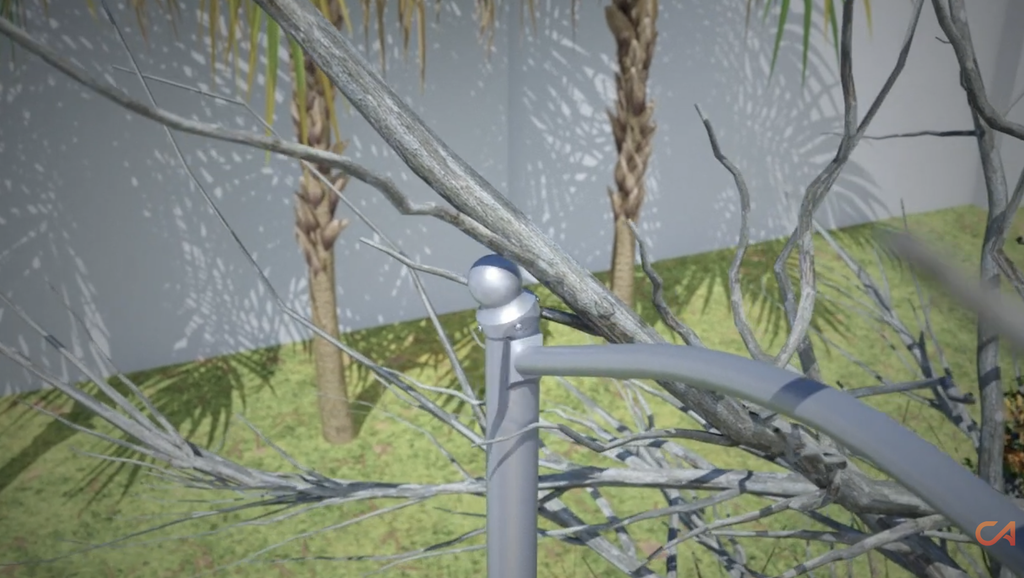
Over years of natural growth, an adjacent tree branch made continuous, repeated contact with the lamppost finial.
Seasonal weather shifts and wind caused the branch to act as a slow wrench. Bit by bit, that constant contact unscrewed the threaded cap over thousands of micro-movements.
On the day of the collision, the finial rested on its final thread. A slight sway from the branch dislodged the heavy metal cap, sending it crashing straight down.
“When a jury cannot see the years of physical wear leading up to an impact, they default to assuming it was just bad luck. 3D animation makes those invisible forces obvious.”
— Brady, Visual Litigation Strategist
Why 3D Forensic Animation in Premises Liability Cases Delivers Verdicts
Proving liability required bridging the gap between biomechanical formulas and jury understanding.
1. Illustrating Time Compression and Traumatic Impact
You cannot easily show a jury “five years of gradual unscrewing” with static paper exhibits.
Through 3D animation, our team compressed years of physical interactions into a clean 30-second sequence. Jurors watched the physical progression unfold in real time before their eyes.
2. Eliminating Defense Ambiguity
Defense attorneys often rely on juror confusion when cases involve subtle engineering mechanics.
By showing the precise physical chain of events and correlating it with medical findings, the animation eliminated speculation. As a result, jurors immediately recognized that routine inspection and maintenance would have prevented the failure.
3. Anchoring Engineering Telemetry
Engineers calculate thread pitch, rotational friction, and terminal velocity, while medical experts evaluate skull impact thresholds and intracranial hematoma risks.
When animators import that exact data into a 3D environment, abstract mathematical formulas turn into undeniable visual evidence.
2026 Trends: Micro-LiDAR Scanning and Environmental Simulation
As legal technology advances in 2026, forensic visualization teams are combining micro-LiDAR spatial scans with real-time physics engines.
As a result, trial teams can recreate historical weather patterns and exact mechanical tolerances faster and more accurately than ever before.
Common Mistakes in Premises Liability Visual Exhibits
Even catastrophic injury claims involving skull fractures or hematomas can fail to persuade if trial exhibits make critical errors:
- Failing to model exact dimensions: Using generic 3D stock models instead of measuring the actual object’s thread pitch and weight creates credibility gaps during cross-examination.
- Over-dramatizing the visual: Adding Hollywood-style camera shakes or artificial sound effects can make the exhibit look biased, risking exclusion under Rule 403.
- Ignoring environmental factors: Showing a physical strike without accurately reflecting biomechanical tolerances and medical imaging (like CT scans showing hematoma location) weakens the scientific foundation of your argument.
Elevate Your Legal Strategy with Proven Visual Litigation
Using 3D forensic animation in premises liability cases translates complex physical mechanics and traumatic injuries into clear, decisive courtroom proof.
When you show jurors the exact chain of causation, you eliminate defense doubts and maximize case valuation.
Handling a complex premises liability or catastrophic injury case?
Contact our forensic visualization team today to discuss your upcoming trial.
Frequently Asked Questions
1. How is 3D forensic animation used in premises liability cases?
3D forensic animation in premises liability demonstrates complex structural failures, dangerous property conditions, and unseen physical wear over time to clearly establish causation for a jury.
2. Why was 3D animation essential in the $23 million lamppost case?
The animation allowed the jury to see how years of subtle tree branch friction gradually unscrewed the metal finial, showing how the falling object generated sufficient impact force to cause a depressed skull fracture and severe hematoma.
3. What data is required to build an admissible premises liability animation?
Animators require site laser scans, object measurements, engineering reports, weather records, and expert witness calculations to ensure the 3D model remains scientifically accurate and admissible.
4. Can 3D forensic animations be used during settlement mediations?
Yes. 3D animations are highly effective in pre-trial mediations because they show insurance adjusters and defense counsel exactly how compelling the evidence will look to a jury.
5. What is the difference between a demonstrative exhibit and a simulation?
A simulation uses computer algorithms to predict what happened, while a demonstrative animation visualizes the explicit findings and telemetry provided by sworn expert witnesses.
Free eBook: The Complete Introduction to Forensic Animation

Whether you are considering animation for one of your cases, or you simply want to be prepared for when the other party uses an animation, our eBook is your guide to understanding forensic animation.