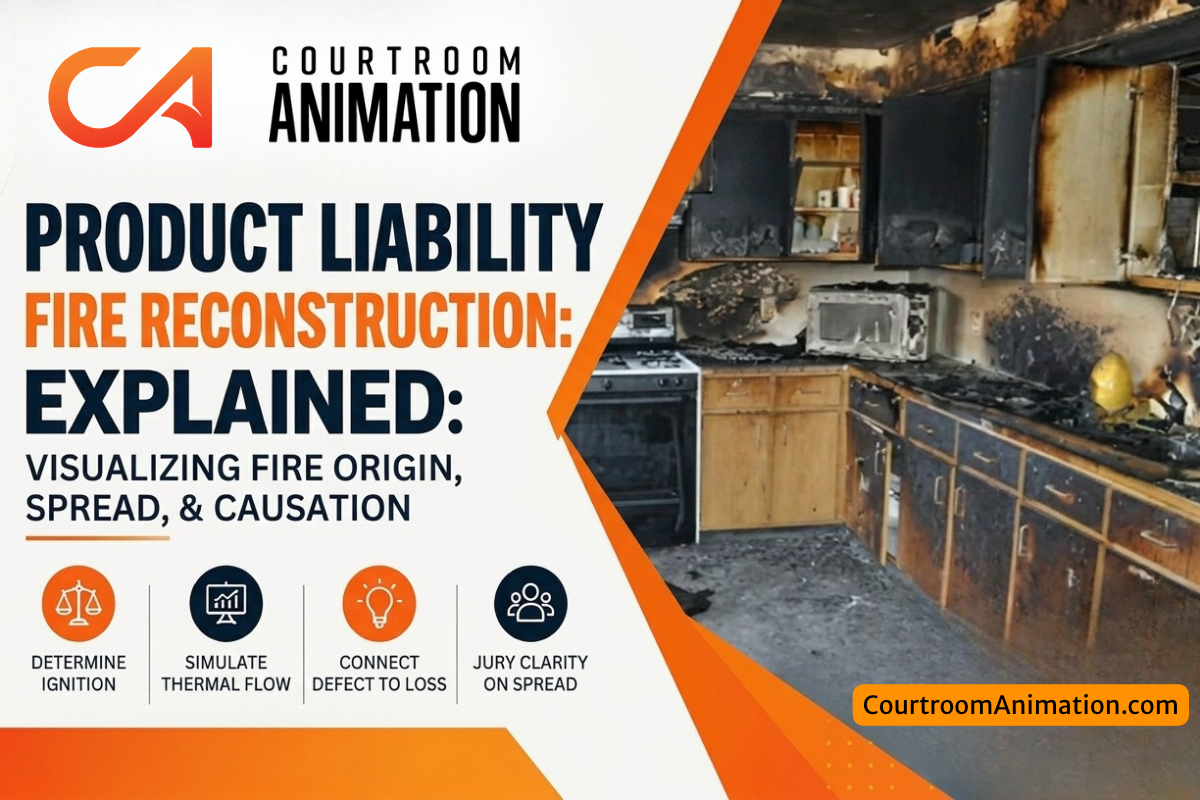
A toaster sits beneath a kitchen cabinet. Someone makes breakfast, removes the toast, and returns the appliance to its usual spot. Then, a fire breaks out.
How can an attorney help a jury understand the sequence of events that may have led to that fire? A product liability animation can show each step in context, from the product’s operation to the resulting damage. Instead of asking jurors to piece together a complicated sequence from testimony alone, attorneys can use a visual demonstration to help explain what allegedly happened and why it matters.
How Product Liability Animation Explains a Fire
In product liability litigation, the order of events can matter as much as the individual facts. A product’s operation, its surroundings, and the actions that follow may all play a role in the questions a case raises.
Consider a toaster-related fire.
Step 1: Show how the product operates
The animation begins with a toaster on a kitchen countertop beneath a cabinet. The user pulls the toaster away from the cabinet, inserts bread, and presses the lever.
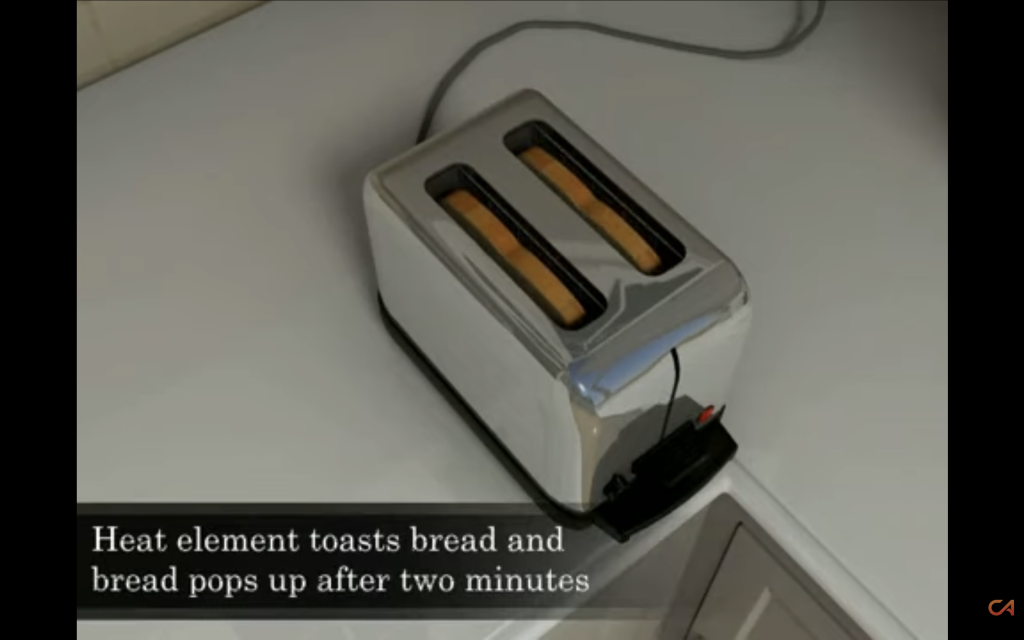
The heating element warms the bread. After approximately two minutes, the toast pops up, and the user removes it.
These opening moments establish the setting and show how the person uses the product. They also give viewers a clear starting point for following the events that follow.
Step 2: Illustrate the critical sequence of events
Next, the animation shows the heating element remaining active after the user removes the toast. The user then moves the toaster beneath the cabinets.
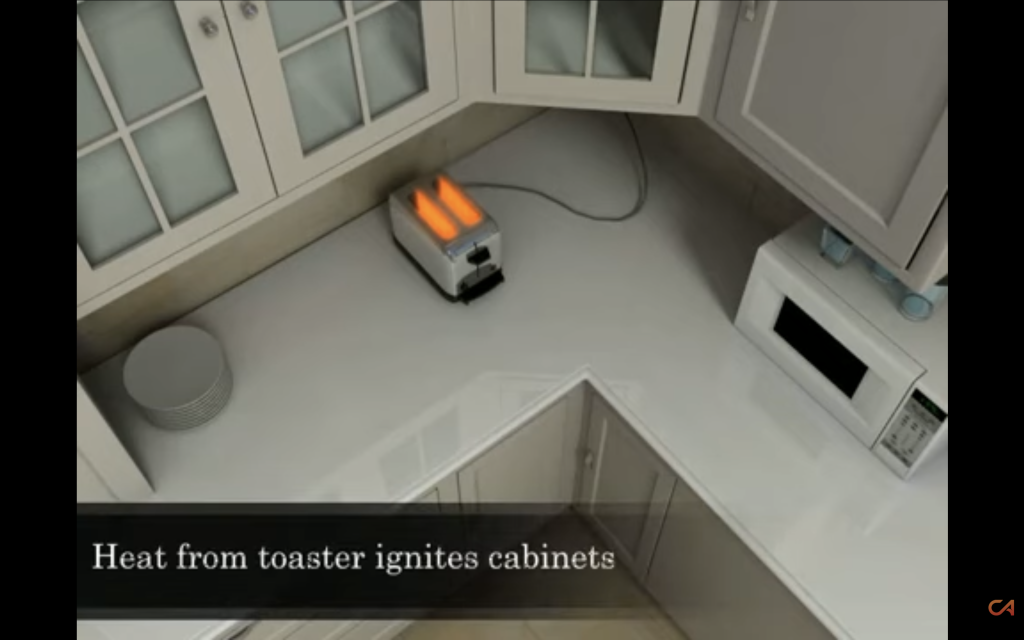
In the illustrated scenario, heat from the appliance ignites the cabinetry. Smoke and flames spread through the kitchen.
By showing these actions in order, the animation helps viewers follow the proposed sequence instead of trying to reconstruct it from a verbal explanation.
Step 3: Connect the animation to actual fire damage
Finally, the video shows an actual photograph of the damaged kitchen.

This transition connects the illustrated sequence to a real-world outcome. Viewers can compare the visual explanation with the documented damage and better understand why the sequence matters to the case.
The photograph serves a different purpose from the animation. The photograph documents the damage it depicts, while the animation illustrates a proposed explanation of how events unfolded. Evidence must support any claimed connection between the two.
Why Attorneys Use Product Liability Animation in Litigation
Product liability cases can involve complicated mechanisms, technical evidence, and competing explanations of an incident. Therefore, attorneys need ways to make those details understandable without losing important distinctions.
A well-planned product liability animation can help explain the evidence in several ways.
Make complex sequences easier to follow
Written reports and expert testimony often contain details that require careful attention. An animation can organize those details into a visual sequence.
For example, a mechanical failure case might involve several moving components. A 3D animation can show how those components interact and illustrate the mechanism an expert identifies as relevant.
Clarify the relationship between a product and its surroundings
Context can matter in a product-related incident. The distance between objects, the placement of a component, or the position of a person may help explain the issues under review.
In the toaster scenario, the relationship between the appliance and the overhead cabinets forms an important part of the illustrated sequence. A visual reconstruction makes that spatial relationship easier to see.
Help jurors evaluate expert testimony
Attorneys and experts often need to explain technical concepts to people without specialized training. An animation can provide a visual reference while an expert explains the relevant facts, methods, and opinions.
However, the animation should support the expert’s explanation rather than replace it. The expert must still establish the basis for any technical conclusions.
Support case presentations beyond trial
Attorneys may also use demonstrative exhibits during mediation, settlement discussions, and other case presentations, subject to the applicable rules and circumstances.
For example, a visual sequence may help the parties discuss how a product allegedly failed or why they disagree about the mechanism of an incident. It gives everyone a concrete visual reference for the issues under consideration.
What Makes an Effective Product Liability Animation?
Realistic graphics alone do not make an animation useful. The strongest work begins with the questions the attorney needs to explain and the evidence available to answer them.
Accuracy comes before visual effects
A product liability animation should reflect the evidence, relevant expert opinions, and assumptions that support the proposed sequence.
The production team should work closely with the legal team and appropriate experts to identify the details that matter. These may include the product’s design, its operating characteristics, the physical environment, and the timing of relevant events.
When evidence leaves a question unresolved, the animation should not present an assumption as an established fact.
Keep the sequence focused
Every scene should help explain an issue relevant to the case. Extra movement, dramatic camera angles, and decorative effects can distract viewers from the evidence.
In the toaster example, the essential sequence is straightforward: appliance operation, removal of the toast, the continued heating, the toaster’s return beneath the cabinets, and the resulting fire damage.
That clear progression gives viewers a structure they can follow.
Distinguish illustration from proof
An animation can show a proposed explanation of an incident. However, the animation itself does not establish that the explanation is correct.
Attorneys should distinguish the facts documented by photographs, physical evidence, and testimony from the actions or mechanisms reconstructed for illustrative purposes. This distinction helps preserve the animation’s credibility and supports a more transparent presentation.
Common Mistake: Letting the Animation Overstate the Evidence
One common mistake involves making an animation more conclusive than the available evidence allows.
For example, a video might depict a toaster overheating and igniting a cabinet. However, that sequence alone does not establish that the toaster contained a defect, that a particular component malfunctioned, or that the product manufacturer bears legal responsibility.
Those questions require appropriate evidence and analysis.
A persuasive animation should not rely on dramatic visuals to fill gaps in the record. Instead, it should clearly distinguish established facts, expert-supported conclusions, and assumptions used to illustrate a possible sequence.
Attorneys should also consider the applicable evidentiary requirements before presenting an animation in court. Under Federal Rule of Evidence 702, qualifying expert testimony must meet requirements concerning helpfulness, sufficient facts or data, reliable principles and methods, and reliable application. Other evidence rules may also apply, depending on how the animation will be used.
The goal is clarity, not exaggeration. A carefully grounded animation can help explain the evidence without asking viewers to accept more than the evidence supports.
Product Liability Animation in 2026: Accuracy, Transparency, and New Technology
Animation tools continue to evolve, including tools that use artificial intelligence to assist with visualization and content production. These developments create new possibilities for presenting complex information, but they also make careful review more important.
For attorneys considering a product liability animation in 2026, the central questions remain practical:
- Does the animation accurately reflect the evidence and the intended purpose of the exhibit?
- Can the legal team identify the sources, assumptions, and technical decisions behind the reconstruction?
- Have the appropriate experts reviewed the details that depend on their knowledge?
- Can viewers distinguish actual evidence from illustrative elements?
- Does the animation comply with the applicable court rules and case-specific requirements?
New technology may help production teams work more efficiently. However, it does not replace expert analysis, factual verification, or legal review.
Federal Rule of Evidence 702 provides an important reference when expert testimony forms part of the presentation. Attorneys should also review the relevant evidence rules and case law governing the proposed use of an animation in their jurisdiction.
How to Decide Whether Your Case Needs a Product Liability Animation
Not every product liability case requires animation. The decision should depend on the issues the legal team needs to explain, the available evidence, and the intended use of the exhibit.
A product liability animation may be worth considering when:
- A product’s internal operation or failure mechanism is difficult to explain through photographs alone.
- The sequence of events plays a central role in the dispute.
- The relationship between a product and its surroundings matters.
- An expert needs to illustrate a technical explanation.
- The parties dispute how a particular mechanism or sequence may have produced the alleged outcome.
For example, a case involving a failed mechanical component may benefit from a close-up animation showing how the component operates. A fire-related case may call for a chronological reconstruction that connects the product’s operation with the surrounding environment and documented damage.
The best approach depends on the case. The animation should address a specific communication challenge, not simply make the presentation look more sophisticated.
Help Your Jury Understand the Sequence of Events
When a product-related incident leads to serious damage, attorneys must explain more than the final outcome. They may also need to show the sequence of actions, conditions, and mechanisms that could account for what happened.
A product liability animation can make that sequence easier to follow. By presenting a proposed explanation step by step and connecting it to relevant evidence, the animation can help jurors understand the issues they must evaluate.
At Courtroom Animation, we create 3D legal animations and demonstrative exhibits that help attorneys communicate complex technical information clearly and accurately.
Have a case involving an alleged product failure, mechanical malfunction, or fire-related damage? Explore our product liability animation services to see how visual evidence may help explain the issues in your case.
Visit CourtroomAnimation.com to learn more about our legal animation services.
Frequently Asked Questions About Product Liability Animation
1. What is a product liability animation?
A product liability animation is a visual reconstruction used to illustrate a product’s operation, an alleged failure, or a proposed sequence of events relevant to litigation. Attorneys may use it to help explain technical evidence and expert opinions.
2. How can a product liability animation help a jury?
An animation can show how components interact, how events may have unfolded, and how a proposed mechanism relates to the surrounding environment. It provides a visual reference that can help jurors follow complex explanations. Its usefulness depends on its accuracy, purpose, and supporting evidence.
3. Can a product liability animation prove that a product was defective?
No. An animation illustrates a sequence or mechanism; it does not independently prove a defect or establish liability. Those conclusions depend on the evidence, applicable legal standards, and any necessary expert analysis.
4. Can attorneys use product liability animations during mediation?
Attorneys may use demonstrative animations during mediation and settlement discussions to explain technical issues and competing explanations. The appropriate use depends on the circumstances of the case, any applicable confidentiality requirements, and the parties’ objectives.
5. What information is needed to create a product liability animation?
The production team may need product photographs, design drawings, inspection records, incident photographs, video footage, expert reports, measurements, and relevant witness accounts. The required materials depend on the case. The legal team and appropriate experts should identify the evidence needed to support the proposed reconstruction.
Free eBook: The Complete Introduction to Forensic Animation

Whether you are considering animation for one of your cases, or you simply want to be prepared for when the other party uses an animation, our eBook is your guide to understanding forensic animation.