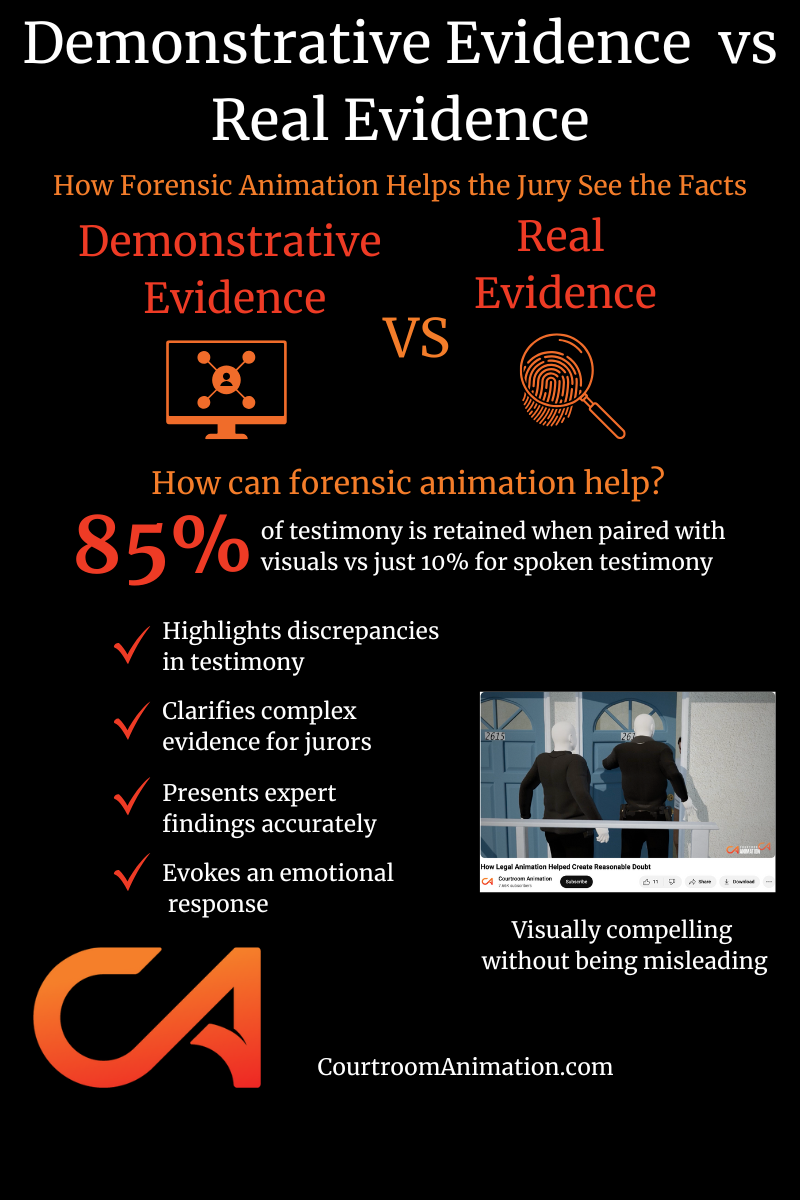
Introduction: Why the Difference Matters in Court
In the high-stakes world of litigation, clarity wins cases. Understanding the difference between demonstrative evidence and real evidence can determine whether jurors walk away confused—or convinced.
When a jury’s decision hinges on technical, emotional, or timeline-heavy facts, you need more than just the facts themselves. You need tools that help those facts come alive. That’s where forensic animation enters the courtroom as a game-changing form of demonstrative evidence.
Real Evidence: Tangible Proof You Can See and Touch
Real evidence—also known as physical evidence—is any tangible object directly connected to the case. According to the Federal Rules of Evidence, it must be authenticated to prove it is what it claims to be.
Examples of real evidence include:
- A weapon used in an alleged crime
- A fingerprint left on glass
- A broken headlight from a collision
Because jurors can see or even handle these items, they often carry a strong emotional and persuasive impact. However, without context, they may leave critical questions unanswered.
Demonstrative Evidence: Making the Facts Understandable
Demonstrative evidence illustrates or explains real evidence. It helps jurors understand events, timelines, and technical details. Unlike real evidence, it is not the object itself—it is a representation of the facts.
Examples include:
- Forensic animations showing an accident sequence
- Diagrams highlighting injury patterns
- Timelines mapping critical events
- 3D reconstructions of crime scenes
These visuals guide jurors through complex information step-by-step, improving comprehension and retention.

How Forensic Animation Builds Juror Understanding
Forensic animation combines accuracy with storytelling. It reconstructs events using verified data and transforms them into a compelling visual narrative.
Transitioning from static images to moving sequences allows jurors to see the events unfold in real time. This not only increases engagement but also strengthens credibility when paired with real evidence.
When done correctly, forensic animation bridges the gap between “here’s the object” and “here’s what happened.”
Studies show that jurors retain only 10% of spoken information after a full trial day. But pair that same testimony with a visual—and retention jumps to 85%.
That means jurors aren’t just hearing your side of the story—they’re seeing it.
When the Stakes Are High, Clarity Is Everything
In a recent criminal defense case, a man wrongfully imprisoned for 11 years walked free. Why? Because a forensic animation recreated a witness’s point of view and proved she couldn’t have seen what she claimed.
Laser-scanned scene data, combined with animation, revealed what words alone never could: Her testimony didn’t align with reality. The jury saw it, believed it, and voted accordingly.
Proof that demonstrative evidence—when executed with skill—has real-world consequences.
Emotion Meets Science
What makes forensic animation so effective as demonstrative evidence? It’s a rare blend of emotional resonance and scientific rigor.
Jurors aren’t engineers or doctors. They’re everyday people asked to make life-altering decisions. When they’re flooded with complex facts—fracture patterns, vehicle trajectories, chain-of-custody debates—they need more than words.
They need a visual they can believe.
When executed correctly, forensic animation:
- Highlights inconsistencies in opposing testimony
- Brings expert analysis to life
- Evokes emotional connection without dramatization
- Clarifies cause and effect in seconds
These benefits underscore the importance of understanding demonstrative evidence vs real evidence—not just in theory, but in courtroom practice.
Admissibility: How to Get It Right
One of the biggest concerns with demonstrative evidence is whether it will be admitted in court.
Here’s the rule: It must be substantially similar to real evidence and not misleading. That’s why partnering with an experienced forensic animation team matters. We ensure every animation is:
- Scientifically accurate
- Verified by expert testimony
- Designed for maximum clarity and minimum bias
With a 99% admissibility rate and over $1 billion in verdicts and settlements supported, Courtroom Animation helps you present visuals that stick—and win.
Conclusion: Turning Complexity into Clarity
In modern trials, pairing real evidence with demonstrative evidence—especially forensic animation—can be the deciding factor in a verdict. Real evidence shows jurors the proof. Demonstrative evidence helps them understand it.
When attorneys blend both, they transform complicated facts into persuasive stories. The result? Jurors who are more informed, more engaged, and more confident in their decisions.
Ready to Show the Jury the Full Picture?
Whether your case involves a wrongful conviction, complex injury reconstruction, or detailed technical analysis, our team can create forensic animations that turn facts into visual understanding. As legal strategies become increasingly complex, the ability to make information clear is no longer a luxury—it’s essential to winning your case.
Let the evidence speak—and let your visuals make it unforgettable.
Free eBook: The Complete Introduction to Forensic Animation

Whether you are considering animation for one of your cases, or you simply want to be prepared for when the other party uses an animation, our eBook is your guide to understanding forensic animation.