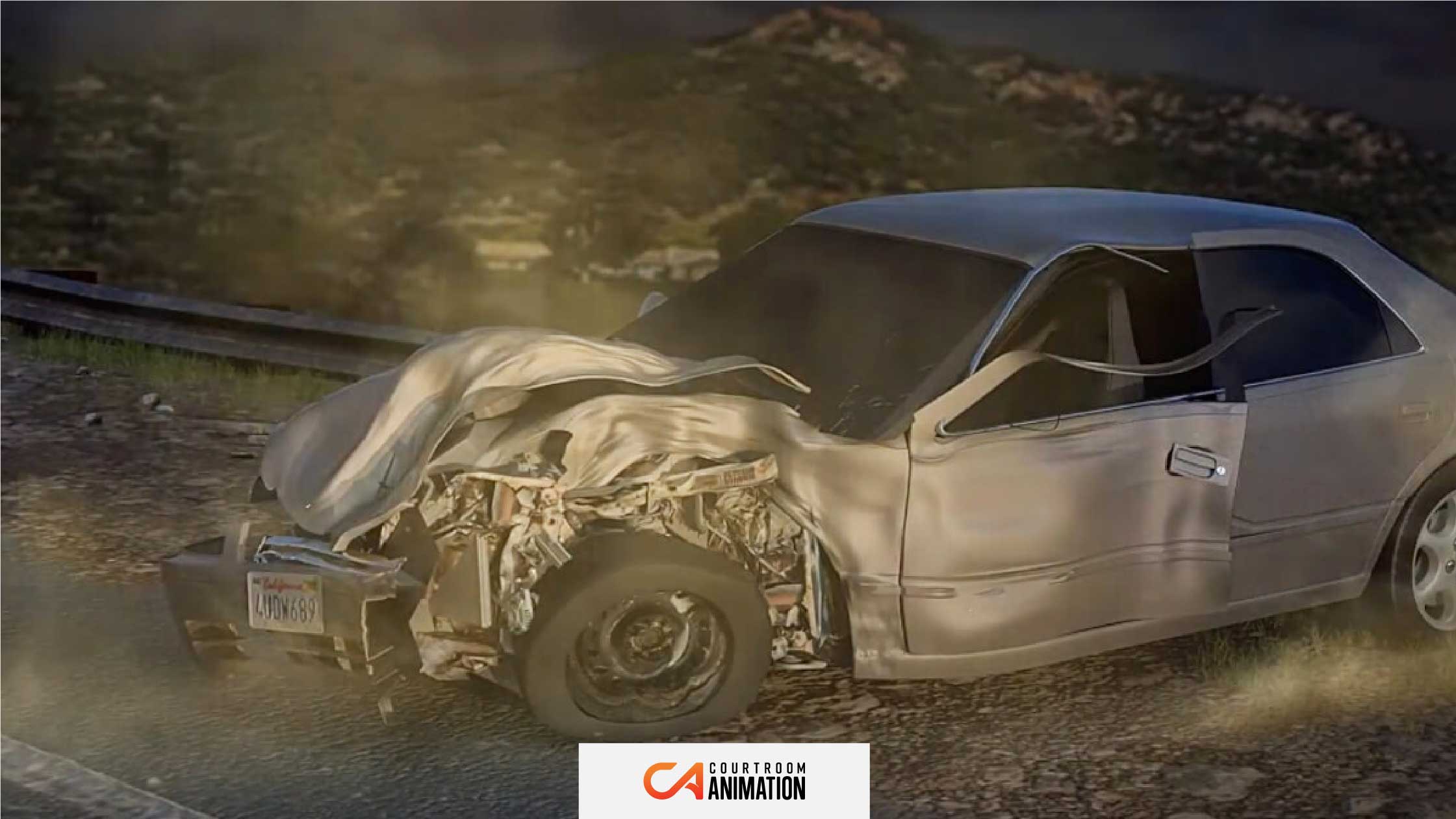
A car crash animation helps juries, and other parties, understand how a collision actually happened.
Motor vehicle accidents often involve complex factors. Speed, visibility, driver behavior, and environmental conditions all influence the outcome. Unfortunately, photographs and reports rarely show the full sequence of events.
Legal teams often present accident evidence in pieces. Police reports show one aspect. Witness testimony describes another. Medical records explain the injuries.
Jurors must mentally assemble those fragments into a story.
A 3D forensic animation solves that problem.
Instead of imagining the crash, jurors can see it unfold. Visual storytelling makes complicated events easier to understand and remember.
Legal professionals frequently use crash animations to demonstrate:
- vehicle movement
- driver behavior
- reaction time
- environmental conditions
- impact mechanics
- injury mechanisms
When jurors clearly understand the sequence of events, they can evaluate the evidence with greater confidence.
1. Car Crash Animation Reveals Driver Behavior
Driver behavior plays a central role in many accident cases. Animations allow attorneys to demonstrate what each person was doing before, during, and after the crash.
Examples include:
- distracted driving
- failure to yield
- speeding
- impaired driving
- sudden lane changes
- pedestrian movement
- cyclist behavior
Behavior is difficult to visualize through testimony alone. Jurors may struggle to picture how events unfolded. A car crash animation recreates those actions visually. The scene can be shown from multiple viewpoints so the audience clearly understands the timeline.
Take this animation, for example, depicting a child cyclist who unfortunately rode into the path of a moving bus:
This animation illustrates several important behavioral elements:
- the cyclist riding along the sidewalk
- a moment of distraction
- the cyclist entering the intersection
- the limited reaction time available to the driver
The animation demonstrates the sequence clearly. Jurors can see exactly how the accident occurred.
Without visual reconstruction, attorneys must rely on testimony and diagrams alone.
2. Time
Timing often determines liability in vehicle collision cases. In many accidents, drivers have only seconds—or fractions of seconds—to react.
A car crash animation allows experts to manipulate time. Animators can slow down or speed up events to clarify what happened.
For example, a collision that occurs in less than two seconds may appear almost invisible in real time.
However, when the moment is slowed down, viewers can observe:
- the vehicle trajectories
- the impact forces
- the direction of movement
- the severity of the collision
This example shows two vehicles traveling at highway speed. When the collision occurs, the animation slows down to reveal the true impact.
At normal speed, the crash might appear minor. In slow motion, the viewer sees the vehicle lift off the roadway.
Animation can also compress time.
For example, surgical procedures that take hours can be condensed into a brief sequence. This approach helps jurors understand the medical consequences of a crash without overwhelming them.
3. Alternative Scenarios
Accident cases often involve conflicting versions of events.
One driver may claim the light was green. Another insists it was red.
A car crash animation allows experts to demonstrate alternative scenarios. At Courtroom Animation, animators often use a technique called ghosted animation. This method visually compares two possibilities.
For example:
Scenario 1
A driver enters an intersection without stopping.
Scenario 2
The same vehicle stops before entering the intersection.
The animation shows both outcomes using transparent or ghosted vehicles. This approach helps jurors understand how different choices may have prevented the accident.
Alternative scenario analysis is particularly valuable in cases involving:
- disputed liability
- intersection collisions
- commercial vehicle crashes
- pedestrian accidents
4. Crash Animations Reveal Multiple Perspectives
Perspective often changes how people interpret an accident. Witnesses may view an event from one angle. Drivers see another perspective entirely.
A car crash animation allows legal teams to present multiple viewpoints.
These can include:
- the driver’s perspective
- an eyewitness perspective
- overhead plan view
- traffic camera angle
- roadway perspective
Take this collision animation, for example:
This animation reconstructs a crash that occurred on a blind curve. The sequence begins with the witness perspective behind the vehicle.
Next, viewers see the crash from the driver’s point of view. This angle illustrates how little time the driver had to react.
Finally, overhead views clarify the vehicles’ positions and trajectories.
Multiple perspectives remove ambiguity. Jurors can evaluate the evidence from every angle.
5. Realistic Animation Improves Juror Understanding
One of the powerful aspects of car crash animation is how realistically events are portrayed. Especially compared to computer-generated simulations, it leaves a better and longer-lasting impression on jurors and other viewers. Mostly, that’s because audiences expect this type of technology.
After all, that’s what they’re used to seeing in modern-day movies, social media, video games, and other media forms. It’s much more powerful than computer-generated simulations due to how outdated that technology looks to an audience. Alternatively, car crash animation takes the simulation data that engineers produce and covers it with realistic graphics (such as skin) to make it more palatable for audiences.
The Bottom Line of Car Crash Animation
Car crash animation transforms complex accident evidence into a clear visual narrative.
Photographs show the aftermath of a collision. Police reports describe the investigation. Medical records explain injuries.
However, animation reveals what happened during the crash.
Jurors can see:
- how vehicles moved
- how drivers reacted
- how the collision occurred
- how injuries developed
By combining technical data with visual storytelling, car crash animation allows legal teams to present evidence in a compelling and understandable way.
For attorneys, investigators, healthcare organizations, and educational institutions, animation has become a powerful tool for explaining vehicle collisions.
Free eBook: The Complete Introduction to Forensic Animation

Whether you are considering animation for one of your cases, or you simply want to be prepared for when the other party uses an animation, our eBook is your guide to understanding forensic animation.
Topics: