
Courthouses across the country continue upgrading their technology: monitors at every bench, digital projectors, and evidence screens large enough for every juror to see. As trials grow more visual, attorneys are turning to medical legal illustration to give jurors clear, memorable explanations of injuries, procedures, and anatomy.
These illustrations are powerful tools for cases involving fractures, internal injuries, surgical errors, medical negligence, and long-term disability. They take complex medical findings and turn them into visual stories a jury can follow.
Below are the key benefits of using medical legal illustration in mediation and trial.
See the Case From the Right Perspective
Every strong legal story begins with perspective. Jurors want to understand how an injury occurred and why it matters. A medical legal illustration provides a visual point of view that anchors the entire narrative.
For example, an illustrated cross-section of a spine can show exactly where a disc was herniated. A labeled diagram of nerves can explain how traction caused permanent damage. Instead of long verbal descriptions, the jury sees an instant, accurate snapshot of the injury.
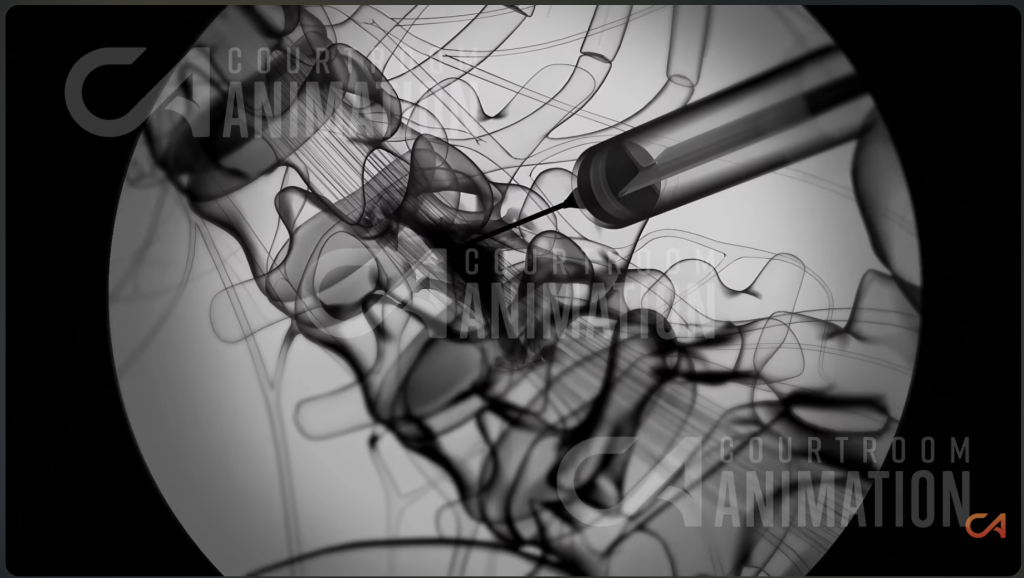
This is critical in cases involving biomechanics, internal injuries, or surgical procedures. According to research from the National Library of Medicine, “If there is a relevant image with the same information, people will retain about 65% of the information 3 days later.”
Medical legal illustrations help you answer the core question:
“What do jurors need to see to understand this injury?”
When shown early — often in mediation — these visuals can also shorten negotiations. Your materials communicate one message clearly: We are ready for trial, and our evidence is strong.
Support Expert Testimony with Clear, Simple Visuals
Experts speak a language most jurors do not understand. Medical terminology, complex anatomy, and long explanations can overwhelm anyone.
Medical legal illustrations keep testimony focused.
They give the expert a map.
They give the jury context.

According to the National Library of Medicine, “According to eye-tracking studies done by the Nielsen Norman Group, users pay attention to information-carrying images,” This means a simple labeled diagram can prevent jurors from missing key testimony during depositions or trial.
Illustrations also help experts avoid confusion or cross-examination traps. Jurors can follow the medical logic step-by-step because the visual stays consistent with the testimony.
“Allow our team to simplify any biological process, medical procedure, physician’s treatment or injury with illustrations that strengthen the themes of your case.”
Courtroom Animation
Clarity builds trust.
And trust drives verdicts.
Clarify Dates, Treatments, and Timelines
Birth injury cases, delayed diagnosis claims, orthopedic injuries, and surgical malpractice suits all share one problem: timelines are complicated.
Medical legal illustrations work with timeline graphics to show:
- When symptoms began
- When interventions were missed
- How injuries progressed
- What imaging revealed at each stage
Instead of forcing jurors to track months or years of medical history, visuals display the sequence in seconds. This reduces confusion and strengthens causation.
“Trial is about story. And the best stories paint a picture in the mind of the listener.”
Colin M. Jones, Esq.
With clear visuals, timelines become part of the story — not an obstacle to it.
Show the Mechanism of Injury With Precision
Every injury has a cause. But explaining that cause is often difficult. Medical legal illustrations show:
- Where the injury happened
- What tissues were damaged
- How force or negligence played a role
- Why the injury created long-term consequences
For example:
- A nerve compression illustration can help jurors understand chronic pain.
- A shoulder anatomy drawing can explain brachial plexus injuries.
- A diagram comparing “normal anatomy” to “injured anatomy” can show disruption clearly and quickly.
These precise illustrations cut through jargon and ensure that jurors see the injury exactly as your expert sees it.
If your case involves complex medical facts, medical legal illustration is one of the clearest ways to communicate that story. These visuals enhance expert testimony, simplify dense medical records, clarify timelines, and help jurors understand the true impact of an injury.
Don’t risk confusion, long deliberations, or missed details.
Strengthen your case with accurate, expert-reviewed medical legal illustrations.
Request a no-obligation quote today and see how visual evidence can elevate your next case.
Free eBook: The Complete Introduction to Forensic Animation

Whether you are considering animation for one of your cases, or you simply want to be prepared for when the other party uses an animation, our eBook is your guide to understanding forensic animation.