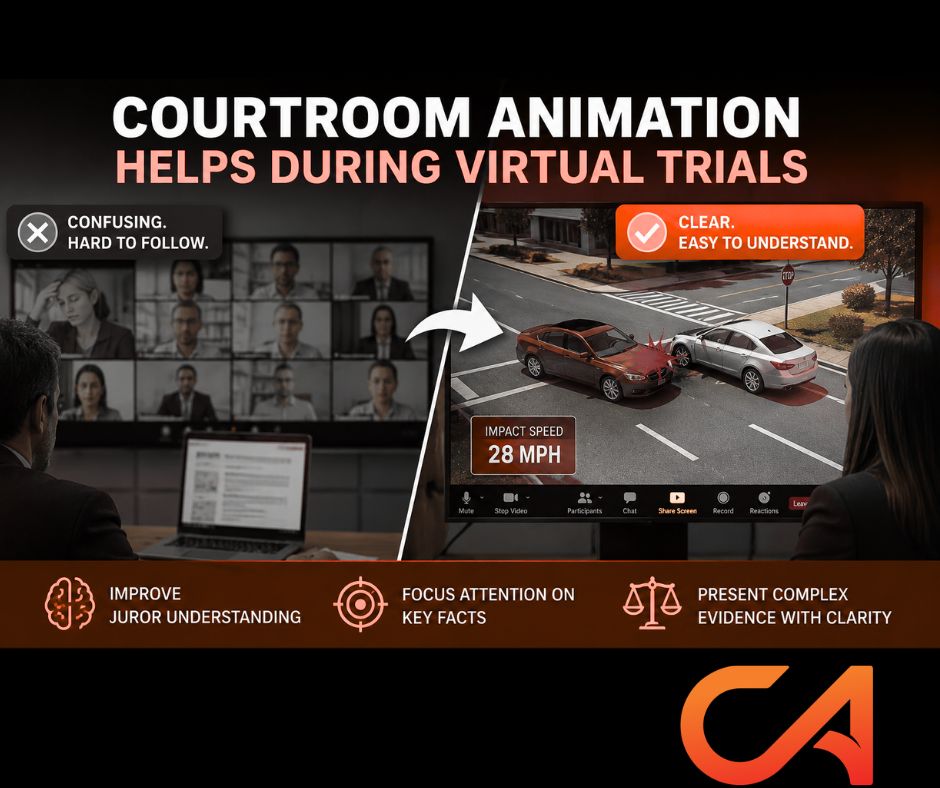
Virtual trials changed how attorneys present cases.
Screens replaced courtrooms. Jurors now watch from a distance. Attention spans dropped. Miscommunication increased.
That shift created a problem.
Complex testimony is harder to follow through a screen and courtroom animation solves that problem. It turns technical facts into clear visuals keeping jurors engaged and helping your case land—even in a virtual setting.
Why Virtual Trials Make Communication Harder
Virtual trials remove key elements of in-person persuasion.
Jurors cannot:
- read body language as easily
- stay fully focused
- visualize complex testimony
As a result, even strong cases can lose impact.
A detailed explanation over Zoom often feels flat. Important details get lost, this is where visual storytelling becomes critical.
How Courtroom Animation Improves Virtual Trial Clarity
Courtroom animation gives jurors something they can see—not just hear.
Instead of explaining a sequence of events, you show it.
This improves:
- understanding
- retention
- confidence in your argument
For example, a motor vehicle accident can be shown from multiple angles. A medical procedure can be broken into steps.
That clarity matters more in a virtual trial than anywhere else.
Keeps Jurors Engaged on Screen
Distractions are everywhere during virtual trials- emails, phones, background noise. If your presentation relies on words alone, attention fades quickly.
Animation pulls focus back. Movement, timing, and perspective guide the viewer. Jurors stay engaged because they are watching—not just listening.
Short, well-timed visuals can hold attention far better than long explanations.
Strengthens Expert Testimony
Expert testimony often becomes harder to follow in virtual settings with audio cutting out, explanations feeling dense. Jurors then struggle to keep up.
Animation supports your expert.
It allows them to:
- walk through key points step-by-step
- point to visual references
- simplify technical language
Instead of asking jurors to imagine a process, you show it clearly.
Helps Overcome Technical Limitations
Virtual platforms are not perfect. Lag, screen size, and resolution can all affect how information is received.
Well-designed animation accounts for this.
It uses:
- clear visuals
- simple layouts
- focused storytelling
This ensures your message still lands—even on a small screen.
Reinforces Your Case During Key Moments
Timing still matters in virtual trials.
Use animation strategically during:
- opening statements
- expert testimony
- closing arguments
Each moment builds your narrative.
A strong visual during closing can leave a lasting impression—especially when jurors revisit it during deliberation.
Builds Credibility in a Digital Courtroom
Preparation shows.
When you present a clear, accurate animation, it signals that your case is organized and well-supported. That perception matters.
It can influence:
- opposing counsel strategy
- mediator perception
- jury confidence
In virtual trials, credibility often comes through presentation quality.
When Should You Use Courtroom Animation in Virtual Trials?
Not every case needs animation.
But it becomes valuable when:
- the facts are complex
- expert testimony is technical
- multiple perspectives exist
- the timeline is difficult to explain
If your case requires explanation beyond basic testimony, animation can help.
The Bottom Line
Virtual trials are not going away and they require a different approach.
Clear communication wins cases. Visual storytelling makes that possible.
Courtroom animation helps you:
- simplify complex facts
- keep jurors engaged
- strengthen expert testimony
- deliver a more persuasive argument
In a digital courtroom, what jurors see matters more than ever.
Ready to Strengthen Your Virtual Trial Strategy?
What is courtroom animation in virtual trials?
Courtroom animation is a visual tool used to explain events, injuries, or processes during a trial. In virtual trials, it helps jurors understand complex information more clearly.
Why is animation more important in virtual trials?
Virtual trials limit attention and reduce clarity. Animation keeps jurors engaged and makes technical testimony easier to follow.
Can courtroom animation improve jury understanding?
Yes. Visuals help jurors process and remember information better than spoken testimony alone.
When should animation be used in a virtual trial?
Use animation during opening statements, expert testimony, and closing arguments to reinforce key points.
Is courtroom animation admissible in virtual trials?
Yes, as long as it accurately represents the facts and supports expert testimony without misleading the jury.